
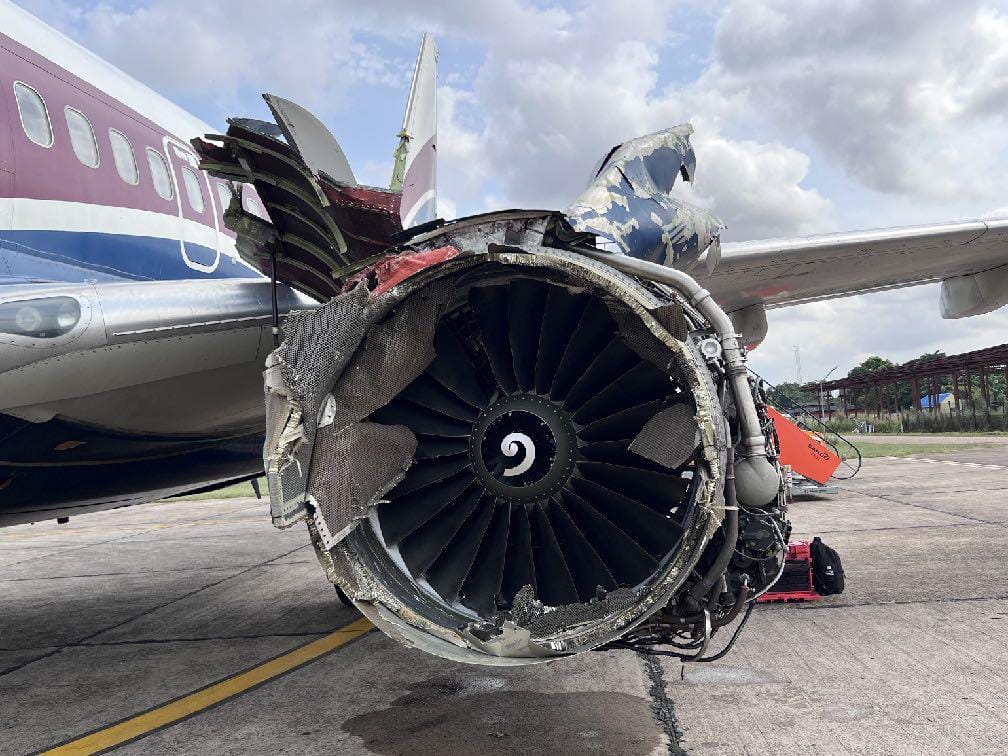
The Nigerian Safety Investigation Bureau (NSIB) has released the preliminary report the serious incident involving Arik Air’s Boeing 737-700 aircraft with nationality and registration marks 5N-MJF which occured on February 11, 2026.
The report disclosed that the catastrophic failure of a fan blade in the left engine triggered the serious in-flight incident involving the aircraft .
The NSIB in its preliminary report said during a scheduled passenger flight from Murtala Muhammed Airport(MMA),Lagos, to Port Harcourt Intentional Airport.
The accident investigation body explained that during the flight, the crew reported an abnormal engine event, that prompted emergency procedures and a diversion to the nearest airport in Benin.
The aircraft, carrying 87 people, NSIB said had just passed flight level 260 and was climbing toward FL290 when the crew heard a loud bang followed by intense vibration and grinding noise from the number-one engine.
The NSIB revealed that nvestigators said that the malfunction caused the aircraft to veer left and begin losing speed, forcing the crew to disengage the autopilot and stabilise the aircraft manually, adding that after confirming severe damage to the engine, the crew shut it down in line with emergency procedures and declared a Mayday.
Air Traffic Control(ATC), NSIB said advised the crew to divert to the nearer Benin Airport in Benin City, where the aircraft landed safely about 30 minutes later. All passengers and crew disembarked without injuries.
The NSIB stated that post-incident inspection revealed extensive damage to the left engine and surrounding airframe.
Investigators, the NSIB said found that the number six fan blade of the engine had broken off, while the remaining blades were chipped and damaged.
The engine cowling had torn open, and fragments caused cuts and dents on the wing, stabiliser and other parts of the aircraft.
The NSIB said that preliminary findings indicate that the fan blade failure inside the CFM56-7B engine likely initiated the chain of events that led to the emergency diversion.
The engine, which had previously been installed on other aircraft before being fitted to the incident aircraft in 2022, had undergone ultrasonic inspections in March 2025 with no defects reported at the time.
The NSIB said further metallurgical examinations of the broken fan blade and the remaining blades, as well as a full teardown of the engine, will be conducted to determine the exact cause of the failure as the investigation continues.
About The Author