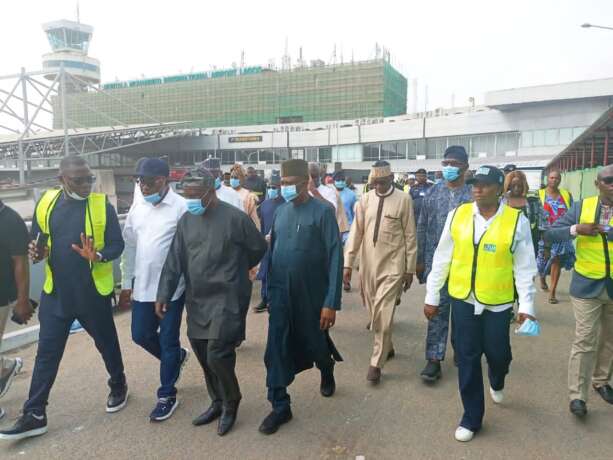
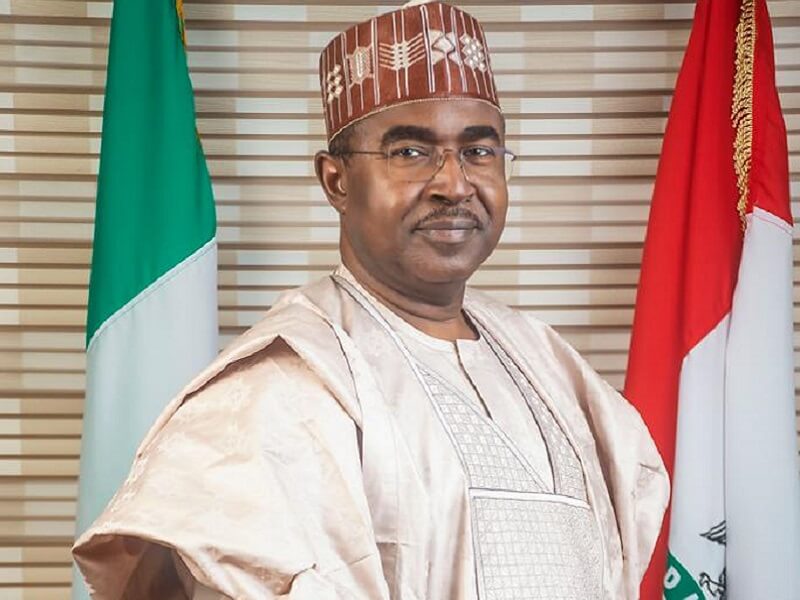
- Photo caption: Buba Marwa
The Chairman/Chief Executive Officer of the National Drug Law Enforcement Agency(NDLEA), Brig General, Buba Marwa (Rtd) has asserted that the ongoing amendment of the NDLEA Act, will significantly enhance the organisational capability of the agency to tackle the menace of substance abuse and illicit drug trafficking in the country when passed into law by the National Assembly.
He made the assertion while making his remarks at the opening ceremony of the Inter-Ministerial Committee (IMC) on Drug Control meeting on Thursday 7th March 2024 in Abuja.
According to Marwa, “We have to acknowledge, however, the existence of the funding challenge, which is limiting our capabilities in various ways. Nonetheless, we are looking forward to some positive developments that will lend impetus to the attainment of our set objectives.”
Continuing, Marwa said, “one such is the amendment of the NDLEA Act, which will significantly enhance the organisational capability of our agency in drug supply reduction. The hearing of the amended bill is making progress in the National Assembly and we look forward to it scaling the final hurdles”,
He acknowledged the tremendous work of the IMC in the implementation of the
National Drug Control Master Plan (NDCMP) 2021-2025, he said the collaboration from stakeholders towards achieving the stated goals of the NDCMP is also deserving of appreciation.
The NDLEA boss listed some of the activities and achievements of NDLEA in 2023 in line with the national action plan on drug control.
Speaking further, Marwa said that, “After taking stock of key programmes implemented across the strategic pillars in 2022 and 2023, I can say that we have recorded significant progress on the 4th National Plan (NDCMP 2021-2025) compared to previous ones. Under the Supply Reduction Pillar, our operations and offensive action led to the arrest of 13, 664 drug traffickers, of whom 3, 412 have been convicted in 2023. We recorded the seizure of 1.61 million kilograms of assorted illicit drugs, and we carried out the destruction of 206.5 hectares of cannabis farms.
“In Drug Demand Reduction, we recorded the counselling and rehabilitation of 10,904 individuals. The implementation of WADA advocacy across states, local government areas, wards, and communities boosted the attainment of some set targets under the Drug Demand Reduction Pillar. Ramping up our WADA sensitisation activities has enabled us to reach different target groups, and, by the same token, has facilitated the diffusion of shared ownership of the effort to curb the proliferation, trafficking and abuse of illicit substances in the country”
He stated that generally, there had been momentous developments in 2022-2023 that were helpful to the attainment of our targets.
This, he said includes: Nigeria’s hosting of the 30th Conference of the Heads of Drug Law Enforcement Agencies, Africa, HONLEA, in September 2023, the commissioning of the NDLEA toll-free helpline, which has helped to bridge the gap between people who need treatment and the care provider, and the Drug Prevention, Treatment and Care (DPTC) training for the Governors’ Spouses, which has helped to strengthen response to drug problems across the states through the first ladies who are at the helm of the leadership of the State Drug Control Committee, SDCC. And, of course, the non-stop WADA campaign across the federation continually gives us leverage in society.”
Speaking, the Country Representative, United Nations Office on Drugs and Crime(UNODC), Oliver Stolpe said, “the achievement over the past years in enhancing law enforcement, increasing accessibility to treatment and rolling out prevention, and recently including harm reduction and Alternative Development, are all milestones that the NDLEA has created. The UNODC is grateful, and hopes that during the presentation by Nigeria at IMC International midterm review, Nigeria makes a great contribution to the world and inspires others in ways to take this fight against drug use and supply to the next level.”
On his part, the Representative of ECOWAS Commission, Dr. Daniel Akwasi Amankwaah pointed out that “ECOWAS is excited about the NDLEA drug control master plan because ECOWAS took inspiration from the NDLEA master plan to encourage other countries to develop their own master plan. I am glad to announce that of the 15 ECOWAS countries, 14 have developed their master plans. This is to say 99 per cent of the countries have developed theirs and it is all thanks to the template of the NDLEA”
Also speaking,the Special Adviser to the Chairman/CEO on NDCMP, Otunba Lanre Ipinmisho said the meeting was called to assess the efforts made by the IMC members so far, identify challenges and proffer solutions.
A communique issued by the IMC at the end of the meeting enumerated some of the solutions, which they want governments at all levels and other stakeholders to focus on.
This includes: “a declaration of a State of Emergency in the face the overwhelming statistics of drug trafficking and abuse and its devastating consequences on the public health, economy and security of the country, to underscore the need for greater resources to be committed to fighting drugs problem and its attendant consequences such as banditry, kidnaping, assassination, insurgency, terrorism and general insecurity.
About The Author