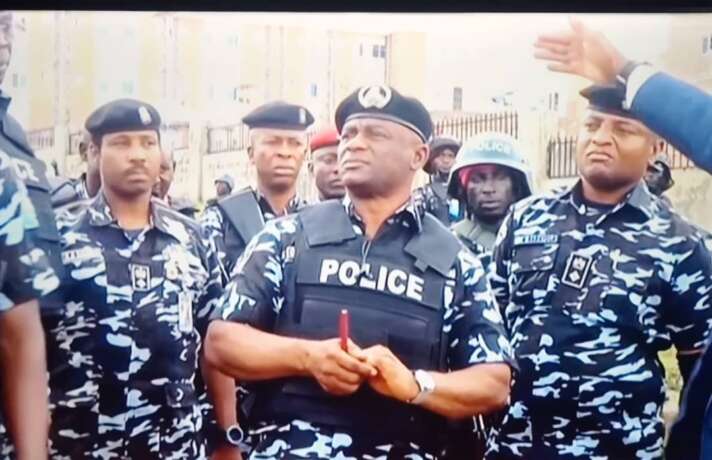
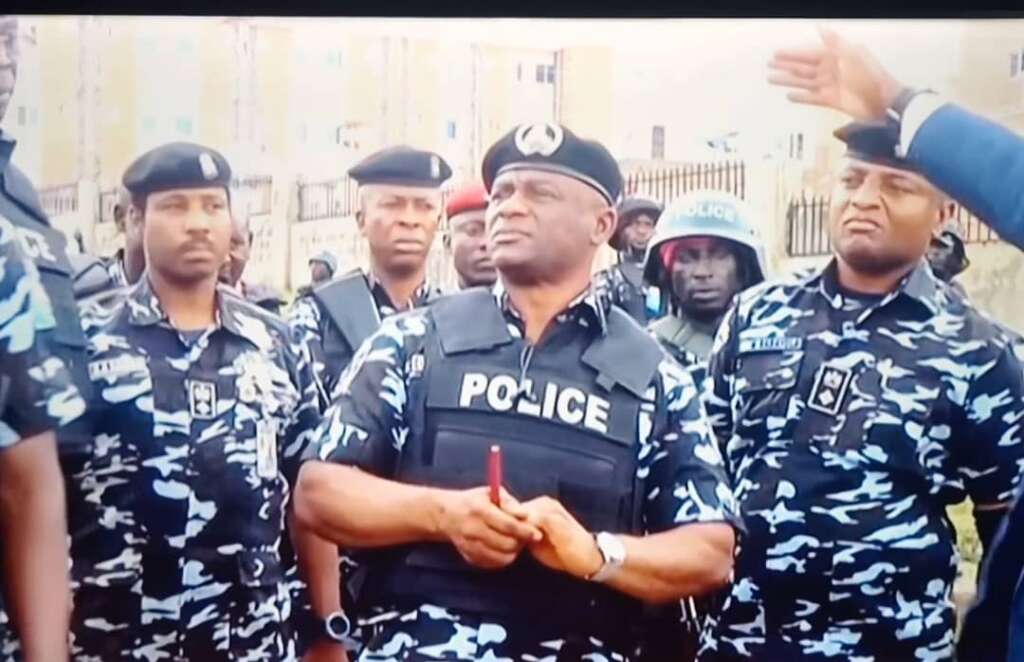
As a way of educating the citizens on the history of the Nigeria Police Force, we are going to review the structure from past Inspector Generals of Police(IGP), who while in active service were the Head and Chief Executive Officer in charge of administering the whole NPF of the country.
Departments in the Force Headquarters under DIGs, Department of Finance and Administration, Department of Training and Development, Force Criminal Investigation Department, Department of Information and Communication Technology,Department of Operations, Department of Logistic and Supply,
Force Intelligence Department, Department of Research & Planning, The Force Secretary.
Number of Zonal Offices for effective supervision of commands under AIGs namely;
Police Zone One
Police Zone Two
Police Zone Three
Police Zone Four
Police Zone Five
Police Zone Six
Police Zone Seven
Police Zone Eight
Police Zone Nine
Police Zone Ten
Police Zone Eleven
Police Zone Twelve
Police Zone Thirteen
Police Zone Fourteen
Police Zone Fifteen
Police Zone Sixteen
Police Zone Seventeen
Formations or Commands under Commissioners of Police or AIGs as the case may be.
Maritime
Police Co-operative
Police Academy Kano
Marine Police
Counter Terrorism Unit among others. 36 State Commands and FCT and special Commands under Commissioners of Police(CPs).
The Nigeria Police Force is the principal law enforcement agency in the country. Nigeria Police was first established in 1820. A 1200-member armed paramilitary Hausa Constabulary was set up at inception. A similar Force was formed in Calabar in 1894 and named “The Niger Coast Constabulary” it was formed under the newly proclaimed Niger Coast Protectorate.
In the North, the Royal Niger Company set up the Royal Niger Company Constabulary in 1888 with headquarters at Lokoja and The Lagos Police, which was established in 1896.
When in the early 1900s, the Northern and Southern Nigeria protectorates were declared, the Northern Nigeria Police was formed from a portion of the Constabulary of Royal Niger Company. The portion of the Constabulary of Niger Coast formed the Southern Nigeria Police.
In 1914, the different police forces were merged for “administrative convenience.” From that moment on, the police were administered from Lagos.
Its main purpose was to stifle dissent to colonial rule. Asides from a few isolated cases, our Police was never actually an investigating force.
In the 1960s, under the First Republic, these forces were first regionalised and then nationalised. The NPF performed conventional Police functions and was responsible for;
Internal security safety in the general
penitentiary, immigration, and custom house institutions support
Executing military obligations in or outside the country.
The British merged the Lagos colony and the Southern and Northern protectorates in 1913 and named the new colony Nigeria.
The Northern and Southern regional police forces were later merged in 1930, to form the colony’s first national police
The Nigeria Police Force” (NPF).
In late 1986, the NPF was reorganised nationwide into seven Area Commands, which superseded a Command structure corresponding to each of the states of Nigeria. Each Command was under a Commissioner of Police and was further divided into police provinces and divisions under local officers. NPF headquarters, which was also an Area Command, supervised and coordinated the other Area Commands.
Later these Area Commands were grouped under Zone Commands as follows: Zone 1, Headquartered Kano, with Kano, Katsina, and Jigawa Commands, Zone 2, Headquartered Lagos, with Lagos, and Ogun commands, Zone 3, Headquartered Yola, with Adamawa, and Gombe Commands.
In mid-1989 another NPF reorganisation was announced after the AFRC’s acceptance of a report by Rear Admiral Murtala Nyako.
In 1989 the Nigerian Police Force also created a Quick Intervention Force in each state, separate from the Mobile Police Units, specifically to monitor political events and to quell unrest during the transition to civil rule.
Each state unit of between 160 and 400 police was commanded by an Assistant Superintendent of Police (ASP) and equipped with vehicles, communications gear, weapons, and crowd control equipment, including cane shields, batons, and tear gas.
A Federal Investigation Bureau (FIB) was to be set up as the successor to the Directorate of Intelligence and Investigation; three directorates were established for operations, administration, and logistics, each headed by a Deputy Inspector General(DIG)
In February 1989, the them President, Ibrahim Babangida abolished the Police Service Commission(PSC) and established the Nigeria Police Council(NPC)in its stead, under direct presidential control. The new council was chaired by the President; the Chief of General Staff, the Minister of internal Affairs, and the Police Inspector General were members.
As part of the government reorganization in September 1990, Alhaji Samaila Gwarzo, formerly SSS Director, was named to the new post of Minister of State, Police Affairs.
Sections 214 to 216 of the 1999 Constitution of Nigeria provides for the Nigeria Police Force. Section 214 of the 1999 Constitution (As amended) categorically states that,
“There shall be a Police Force for Nigeria, which shall be known as the Nigeria Police Force, and subject to the provisions of this section, no other police force shall be established for the Federation or any part thereof”.
The Police Act, however, regulates the activities of the Police Force. Section 4 of the Police Act provides that,
“The Police shall be employed for the prevention and detection of crime, the apprehension of offenders, the preservation of law and order, the protection of life and property and the due enforcement of all laws and regulations with which they are directly charged”
Officers and men of the Force are deployed across the 36 states of the Federation and the Federal Capital Territory (FCT), Abuja to fight crimes, criminality and ensure the maintenance of law-and-order vis-a-vis peaceful co-existence in the society.
The operational command and control of the Nigeria Police Force is under the Inspector General of Police. Section 215 (1) (a) of the Nigerian Constitution states that,
“There shall be an Inspector-General of Police, who, subject to section 216(2) of this Constitution shall be appointed by the President on the advice of the Nigeria Police Council from among serving members of the Nigeria Police Force”
The Nigerian Police (NP) is designated by the 1999 constitution as the national police of Nigeria with exclusive jurisdiction throughout the country. Constitutional provision also exists, however, for the establishment of separate NPF branches “forming part of the armed forces of the Federation or for their protection of harbours, waterways, railways and airfields.
Recommendations and Suggestions For Enhancement Of Standards and Professionalism In the Police Force
(A) Re- jigging the system wholisticarly from the least rank to the top to understand the new narrative instead of ” Police is your Friend” it could be ” People Friendly Police”.Which signals a Civil- Police relationship void of excessive use of force on citizens and deploying diplomacy and strategic policing.
(B). Recruitment system must take note of Merit,Character,Competence and Capability to serve the country patriotically and committedly.
(C).Posting policy to be tailored towards deploying officers or personnel based on effectiveness,merit,competence,capability,loyalty,and sound judgement at work.
(D)Training Schools to have standard curriculum and training program that is world standard or global standard.
(E).Need to emplace authority, seniority, hierarchy,smooth career progression, addressing stagnation,due promotion and fair hearing for the public and personnel whenever there are issues arising through a sound legal framework and judicial upgrade in the police act.
(F)Upgrading the Police operational and tactical arms to meet with global standard especially the Mobile Police Force (MOPOL), IGP Tactical teams, CTU,NCB among others to make the police most relevant for the task assigned to the Force.
(G).Voiding the Police Force appointment from political whims and caprices,pursuant to Merit, Pragmatism, Competence,Capability and Character of appointees for inclusivity and fairness to all.
(H)Need to upgrade Operational Vehicles in use to meet with world standard,instead of vehicles supplied by CSR,the Force should purchase a specific grade of vehicles that meets it’s need and standard.
(I). A well programmed life insurance,Pensions and welfare packages with increase renumeration during and after active service years as obtained in the Military.
(J).People Friendly and Oriented Policing. The Newly Appointed Acting IGP Olatunji Rilwan Disu should be given the opportunity to redesign and strategically turn around the system by not distracting him with diversionary issues,but all hands must be on deck to make policing a whole nation approach”.
Security is everybody’s business” not police alone as an agency.
James Sunday,is the Chief Executive Officer,Hallvive Media and Communications Limited Abuja, Nigeria.About The Author