…Says It May Withdraw Services If Issues Raised Are Not Addressed
The National President of the Nigerian Air Traffic Controllers Association (NATCA), Comrade Amos Edino says there is no improvement in the communication and surveillance infrastructure, calling on the Federal Government to urgently address the issues.
This is as he warned that NATCA may be forced to withdraw its services if there is no clear strategic plan for the total overhaul of communication and surveillance infrastructure .
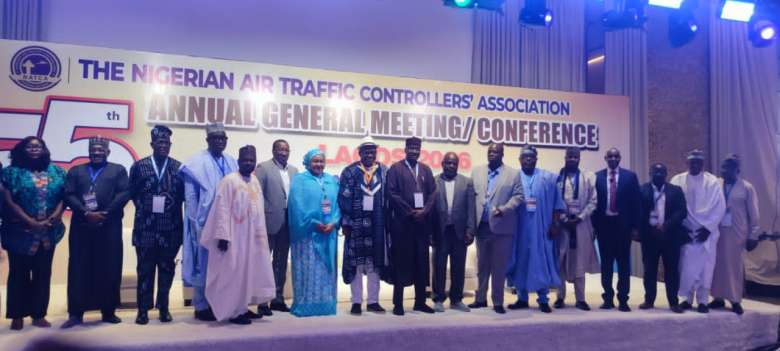
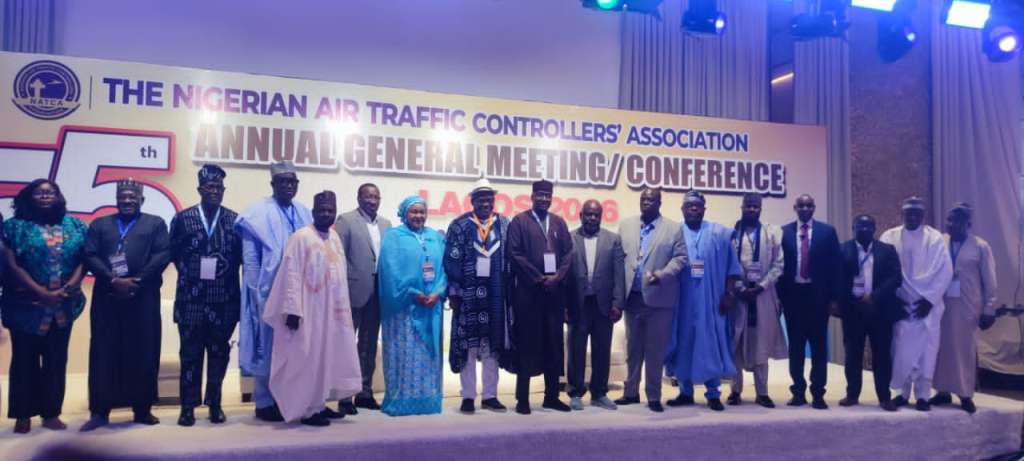
He said this at the 55th Annual General Meeting(AGM) with the theme, ” Beyond Silos To Synergy : Shaping the Future of Nigerian Air Traffic Management” held today in Lagos.
On infrastructural development, the President said that the year under review has been a difficult one for association.
He noted that despite the considerable challenges faced by ATCOs across the length and breadth of the country, there has been no significant improvement in its communication and surveillance infrastructure.
According to him, “We acknowledge the approvals and procurement milestones that have been announced. However, these have yet to translate into a material improvement in the equipment available to controllers at the console.”
NATCA, he hinted has sought a high-level presentation of its position to the Minister, the National Counter Terrorism Centre, the Office of the National Security Adviser and the management of NAMA.
The President said the association has also submitted a memorandum to the National Assembly on aviation funding reform, in which NATCA make the case that safety-critical infrastructure requires predictable and ring-fenced funding.
He pointed out that it is with a deep sense of responsibility that this frustrating engagement is pushing the association towards considering the withdrawal of its services, should there be no clear strategic plan for the total overhaul of communication and surveillance infrastructure in Nigeria.
Significant attention to these two areas of infrastructure, he said would:improve the safety of Nigeria’s airspace, reduce economic waste and improve profitability for airline operators, attract more airlines to Nigeria’s airspace, with a corresponding increase in government revenue, strengthen the security of airspace and national security architecture; and improve Nigeria’s global rating.
“Minister, we make this call not as a threat, but as patriots who sit daily before screens and failing frequencies to keep this country safe,” the President said.
On the international visibility globally and within AFM region, the President said that NATCA’s visibility at the global level and within the Africa and Middle East Region continues to grow.
He said that at the just-concluded 37th IFATCA Africa and Middle East Regional Meeting in Amman, Jordan, Mallam Ahmad Abba was re-elected Executive Vice President, IFATCA Africa and Middle East Region, and Mr. Shettima Babazau was elected Regional Vice President, West African Region.
“We congratulate them both,” he said.
NATCA members, he said also serve on various IFATCA committees at global and regional levels.In April this year, NATCA hosted the IFATCA/ITF Workshop in Lagos.
The five-day workshop, he informed brought together participants from across Africa and was successfully concluded, adding that young ATCOs are being encouraged to write working papers and are being entrusted with responsibilities, as a deliberate investment in the future leadership of the Association.
Speaking at the event, the Managing Director of the Nigerian Management Agency (NAMA), Engr. Faruk Umar said that that the NAMA management recognises that NATCA’s operational effectiveness is directly linked to the quality and reliability of equipment and infrastructure.
The Managing Director was represented by the Director of Air Traffic Services, NAMA, John Tayo.
The Managing Director said the agency recently acquired Automatic Dependent Surveillance–Broadcast (ADS-B) equipment, adding that it is an important milestone in efforts to strengthen surveillance capabilities, improve situational awareness and enhance the overall safety and efficiency of air traffic management in Nigeria.
“Furthermore, management is actively pursuing a comprehensive overhaul of our radar systems. We recognise that some of our existing radar infrastructure requires significant upgrading to meet contemporary operational demands.
“Our objective is to achieve a more reliable, efficient and technologically advanced surveillance network that will support safer skies and improved service delivery.In addition, management is engaging with ASECNA to explore technical assistance and support in addressing some of the persistent challenges affecting our communication equipment.
We are optimistic that this collaboration will contribute significantly to improving the reliability and availability of our communication infrastructure,” Umar said.
These initiatives, the NAMA boss pointed out demonstrate NAMA’s determination to move beyond routine maintenance towards sustainable technological renewal.
On training and manpower development, he said NAMA remain conscious that its greatest asset is the people, adding that no investment in infrastructure can deliver its full potential without a competent, adequately trained and motivated workforce.
“I am delighted to announce that the first batch of our overseas training programme has commenced. This marks a significant step in our commitment to exposing our personnel to international best practices, modern operational procedures and emerging developments in air traffic management.
“The programme will be implemented in phases to ensure that more officers benefit from international exposure and professional development opportunities.
“Our objective is to build a workforce that is not only technically competent but also confident, innovative and prepared for the evolving demands of the aviation industry,” he said.
About The Author