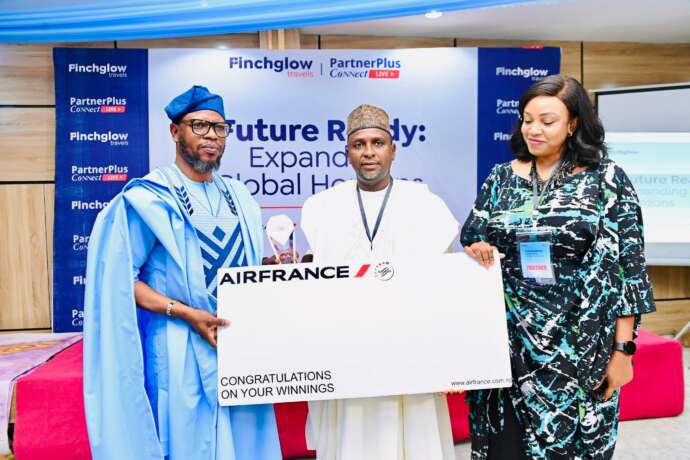
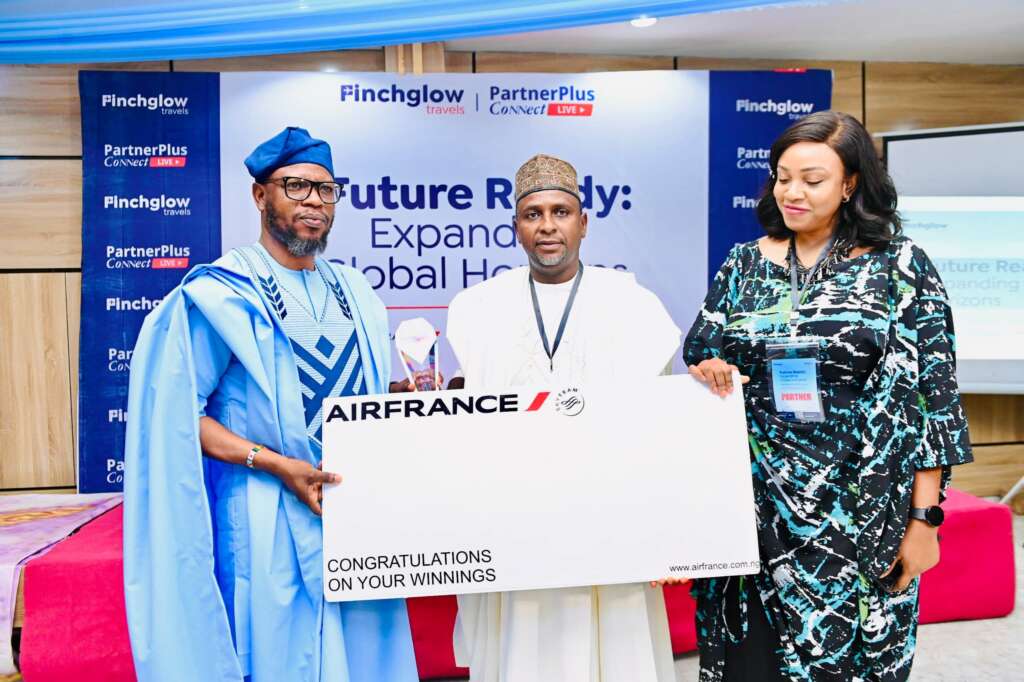
Photo caption : From left to right: the Managing Director, Finchglow Travels, Ezekiel Ikotun;, the CEO, Lincijen Travel & Tours Ltd, Abubakar Mohammed; Key Account Manager, Air France-KLM, Antonia Umunna at the PartnerPlus Connect Live Edition held in Abuja recently
… Says lt Is Time To Reflect On Travel Trade Ecosystem
…Plans To Narrow Knowledge Gap That Makes Nigerian Travel Agents Vulnerable
Finchglow Travels, one of the leading travel trade organisations in Nigeria has said that its mission as it celebrates its 20th anniversary is to drive unstoppable Nigeria travel sector growth and also move millions of passengers annually.
The travel trade organisation, however lamented that the infrastructure holding the travel trade business together is often invisible, underfunded, and misunderstood.
Finchglow Travels argued that the gap between demand and capacity has a cost, adding that for 20; years, it has been absorbing it, pricing the fares that travel agents quote, shouldering the foreign exchange volatility that would otherwise ground small agencies, and negotiating with airlines on behalf of an industry too fragmented to negotiate for itself.
The entity said that this year as it marks its 20th anniversary not with fanfare for its own sake, but as a moment to hold a mirror up to an ecosystem it has quietly held together, and to name, plainly, what a travel consolidator is and why Nigeria cannot afford to keep misunderstanding one.
Finchglow Travels noted that in global aviation markets, consolidators are well understood as they sit between airlines and the travel trade, aggregating inventory, negotiating contracted fares unavailable on the open market, and providing the financial and operational scaffolding that allows thousands of independent travel agents to compete. In Nigeria, that understanding has never quite taken root.
It opined that the result is a structural vulnerability that the sector has only recently begun to acknowledge.
Finchglow Travel’s Managing Director, Ezekiel Ikotun, who spoke on the issue was not only direct about what that gap costs but also what closing it requires.
According to him, “Our goal is to educate our customers, equip them with the right knowledge, and make them global players. We don’t just sell tickets, we consolidate travel into opportunity, savings, and innovation.
Finchglow’s 20-year journey is the story of building that infrastructure almost entirely without a template in a market where airlines, agents, and corporates each operated in silos, where forex policy could reprice a ticket overnight, and where the knowledge needed to run a sustainable travel business was neither documented nor distributed.
“Today, the company powers travel for corporate organisations, retail travel agents, and consumers across Nigeria and beyond.
“Airlines trust it as a settlement partner. Agents rely on it for access to fares, systems, and support they cannot access alone. Corporates use it to manage complex travel programmes in a market where complexity is the norm.
“The 20th anniversary arrives at a turbulent moment for Nigerian aviation. Foreign exchange instability has made airline pricing volatile and settlement uncertain. The margins in travel remain razor-thin. Agents face staffing constraints, limited access to working capital, and widening gaps in digital capability. International airlines continue to weigh Nigeria’s operating environment against their global route priorities,” he added.
Group Managing Director, Finchglow Holdings, Bankole Bernard, reiterated that “Airlines are protecting themselves against instability and uncertainty. Broader foreign exchange and policy challenges largely drive fare volatility and most people operating in this sector are one bad quarter away from finding that out.”
.Speaking further, he said, “Finchglow’s response to these pressures has been structural, not reactive. By leveraging dollar inflows from its corporate client base and negotiating dual-currency settlement arrangements with airline partners, the company has created a buffer that extends beyond itself, allowing agents in its network to transact in naira while Finchglow manages the underlying dollar obligations. In a market where forex exposure has collapsed more than one travel business, this is not a small thing.The company has also invested in building capacity across the sector. Finchglow hosts webinars and live events, publishes weekly industry intelligence, and runs online training designed to narrow the knowledge gap that makes Nigerian travel agents vulnerable.”
He said that three live editions ran in 2025 alone, with plans to deepen the programme’s reach across more cities in 2026.
He pointed out that in Nigerian business, longevity in a volatile sector is not incidental but it is evidence of adaptation, of relationships that held, of a business model that remained relevant through deregulation, a pandemic, and a currency crisis that reshaped the economics of international travel for agents across the country.
Recall that the Finchglow Holdings Group Managing Director, Bankole Bernard, has consistently called for greater government engagement on regulatory inconsistencies and increased domestic investment in aviation infrastructure, including Maintenance, Repair, and Overhaul (MRO) facilities, to reduce the capital flight that continues to weaken Nigeria’s position in regional aviation.
These, he said are not peripheral concerns but structural conditions that determine whether Nigerian travel businesses thrive or merely survive.
“That Finchglow has done more than survive and has brought a significant portion of Nigeria’s travel trade with it is what the 20th anniversary is really marking.As Nigeria’s travel ecosystem continues to navigate structural headwinds, Finchglow enters its third decade with the same posture it has held for twenty years: in the background, holding the infrastructure together, and insisting that an informed, well-resourced travel trade is not a luxury it is the foundation on which the entire sector stands,” he said.
.
About The Author