
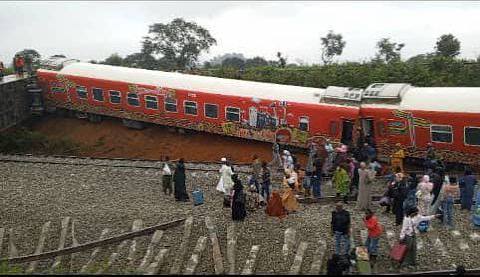
The Nigerian Safety Investigation Bureau (NSIB). said it commenced investigation into the passenger train incident on the Rigasa-Idu corridor near Asham Station in Kaduna State,
NSIB has confirmed the occurrence involved train KA2 operating between Rigasa in Kaduna State and Idu in Abuja.
However, officials said no fatalities were recorded although some passengers sustained injuries.
NSIB informed that the investigation seeks to determine the technical and operational factors that led to the railway incident, which occurs near Asham Station.
According to the NSIB, the railway incident occurred at approximately 09:16 hours along the Jere–Asham section near Asham Station in Kaduna State.
The track segment where the event occurred, the Bureau said lies on a downward gradient.
The KA2 train had departed Rigasa Railway Station earlier as part of its scheduled Rigasa-Idu passenger service.
The train was said to have arrived at Jere Station at about 08:52 hours and departed again at 08:59 to continue its journey to Abuja.
Meanwhile, officials said a rear locomotive was attached at Jere Station to provide additional operational support along the corridor.
The NSIB said that shortly after leaving Jere Station, the rear locomotive reportedly detached from the train, adding that the detached unit then rolled forward along the gradient.
Consequently, it struck the rear section of the moving train, triggering the railway incident under investigation.
At the time of the occurrence, NSIB said that the train configuration included two locomotives positioned at the front and rear. It also comprised one power car, two business class coaches and six standard passenger coaches.
As at the time of the incident, there were 429 passengers on board the train.
In addition, there were 46 crew members onboard along with 24 security personnel assigned to the service.
Following the collision, some passengers sustained injuries although no deaths were reported.
Personnel of the Nigerian Railway Corporation(NRC) immediately initiated emergency response measures.
Medical personnel on the train provided first aid to affected passengers.
Security officials also assisted in managing the situation and ensuring passenger safety.
Despite the railway incident, the train continued its journey after emergency response measures were completed.
The service eventually arrived at Idu Station in Abuja at approximately 10:39 hours.
Additional assistance and support were then provided to passengers at the station.
The development highlights the importance of safety monitoring across Nigeria’s expanding rail network.
Meanwhile, investigators from the NSIB have commenced evidence gathering and analysis into the railway incident.
The probe will examine several factors including train configuration, locomotive attachment systems and operational procedures. In addition, investigators will review operational data and infrastructure conditions along the corridor.
Speaking on the incident, the Director-General of the NSIB, Captain Alex Badeh Jr. expressed concern for passengers affected by the incident.
He noted that every transport journey carries the trust and expectations of hundreds of passengers who rely on the system to reach their destinations safely.
Badeh said that the Bureau approaches every investigation with a strong sense of responsibility because transport occurrences affect real people and families.
He said that the investigative team will carefully examine all relevant factors to understand what happened and identify lessons that can improve railway safety.
The NSIB said that it will work closely with the NR and other relevant agencies during the investigation.
The NSIB assured the public that further updates will be provided as more information becomes available.
The agency pointed out that for global railway safety standards, the Bureau often aligns investigative practices with international transport safety guidelines recommended by organisations such as the International Civil Aviation Organization, which also promotes accident investigation frameworks across transport sectors
About The Author