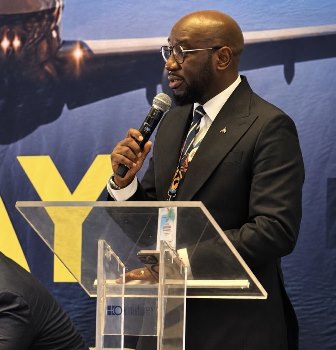
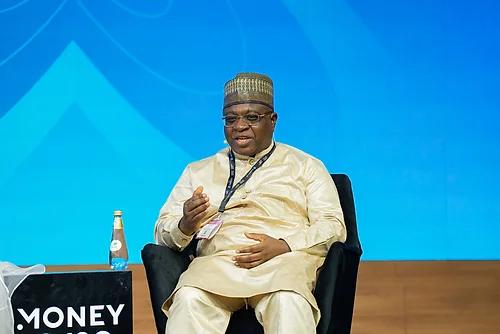
Photo caption: The Chairman of NGX Group, Dr. Umaru Kwairang
The Chairman of NGX Group, Dr. Umaru Kwairanga, says the Dangote Refinery Initial Public Offering (IPO) signals the growing capacity and ambition of Nigeria’s capital market.
Kwairanga made the remarks during a television interview at the Fintech Money 20/20 Middle East held at the Riyadh International Conference Centre in Saudi Arabia.
He said the significance of the Dangote Refinery IPO extends beyond the size of the transaction, noting that it demonstrates the capacity of Nigeria’s public market to support businesses of substantial scale in raising long-term capital and broadening ownership.
According to him, the transaction also provides institutional and retail investors with an opportunity to participate in the growth of a major Nigerian enterprise.
“The Dangote Petroleum Refinery IPO sends an important signal about the capacity and ambition of Nigeria’s capital market,” Kwairanga said.
He added that the transaction could encourage other large Nigerian and African businesses to consider the capital market as a credible avenue for financing expansion and achieving long-term growth.
The NGX Group Chairman also highlighted recent improvements in Nigeria’s market infrastructure, including the transition to T+1 settlement, extended trading hours and Nigeria’s scheduled return to the FTSE Russell Frontier Market universe from September 21.
He said these developments reinforce the message that Nigeria is building a deeper and more investable capital market capable of connecting companies with capital at scale.
Kwairanga said NGX Group is also focused on ensuring that major listings and public offers are accessible to everyday Nigerians.
He explained that investors can participate in public offers through multiple channels, including stockbrokers, banks and approved digital platforms, with NGX Invest providing the underlying infrastructure connecting issuers to distribution channels.
The objective, he said is to broaden ownership of Nigerian enterprises and encourage greater participation by younger and first-time investors.
“As more companies come to market, we want more Nigerians, including younger and first-time investors, to have the opportunity to participate in the country’s economic growth through the capital market,” he said.
Speaking on opportunities to attract more Gulf investors to the Nigerian market, Kwairanga identified financial services, telecommunications, energy, infrastructure and industrial development as sectors with significant investment potential.
He said attracting Gulf capital would require more than simply presenting investment opportunities, stressing the importance of market accessibility, liquidity, regulatory certainty and efficient movement of capital.
While acknowledging improvements in foreign-exchange liquidity and market accessibility, he said Nigeria must deepen its engagement with Gulf sovereign wealth funds, asset managers, family offices and other institutional investors.
He also called for greater visibility for Nigerian companies and increased opportunities for Gulf investors to engage directly with the Nigerian market.
“For me, the opportunity is to build a stronger Nigeria-Gulf investment corridor, connecting significant pools of Gulf capital with credible Nigerian businesses and investment opportunities,” Kwairanga said.
The NGX Group, he said would continue to play a role in developing the infrastructure, partnerships and international connectivity required to strengthen that investment corridor.
On investor protection,
Kwairanga further stressed that increased digital participation in the capital market must be accompanied by stronger investor protection.
NGX Regulation, he said provides independent oversight of the market through surveillance of trading activities, enforcement of market rules and mechanisms for handling investor complaints.
He identified transparency and investor education as additional pillars of investor protection, particularly as more first-time investors access the market through mobile devices.
“A mobile phone can make it easier to access an investment, but it does not remove investment risk,” he said, urging investors to use regulated channels, understand the securities they are purchasing and make informed investment decisions.
“Access and protection have to grow together. Technology can widen participation, but trust is ultimately what sustains a capital market,” Kwairanga added.
About The Author